

Toddler Bed Safety Standards History Simplified
By Maya Chen • 14th Dec
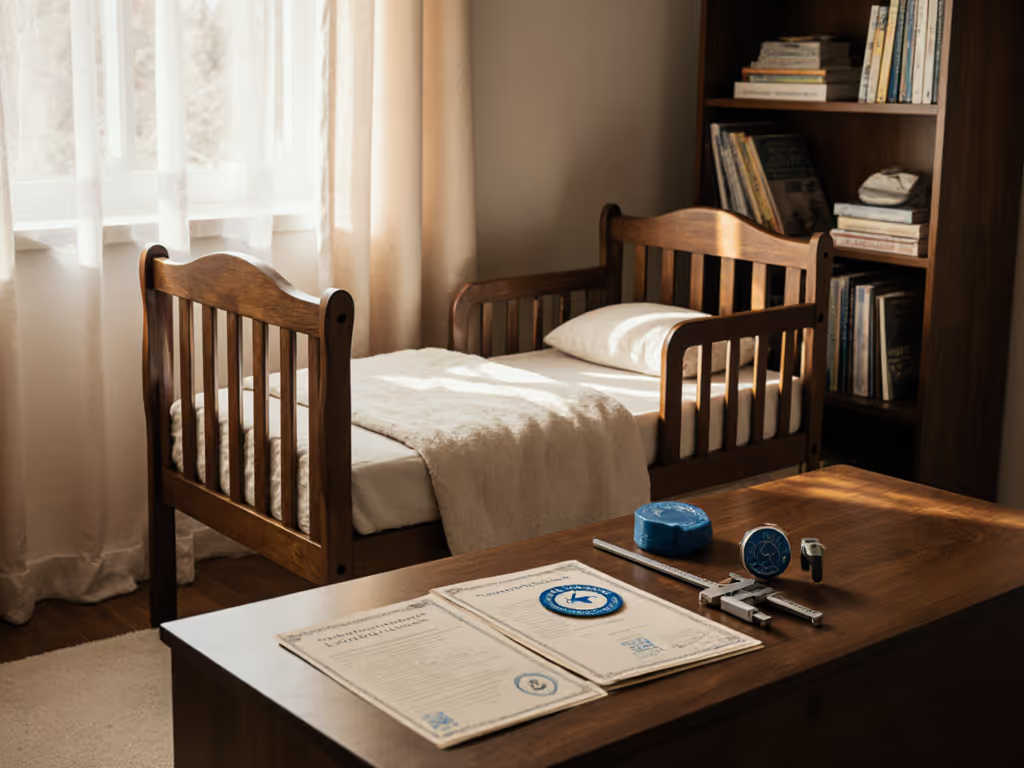
When evaluating compact toddler beds for your micro-bedroom, understanding the toddler bed safety standards history is as critical as measuring your floor plan. If you're comparing beds across regions, see our US vs EU toddler bed standards decoded. The evolving toddler bed regulations directly impact what's safe (and what actually fits) in spaces where every inch must pull double duty. Let's walk through this regulatory timeline to help you identify compliant, space-smart options that clear your nighttime pathways.
Step 1: The Foundation Years (1973-2000)
The U.S. Consumer Product Safety Commission (CPSC) established the first federal historical bed safety changes for infant beds in 1973 (primarily addressing structural integrity and slat spacing). These early standards reduced annual infant deaths from approximately 200 to 50 by 2011, though injury rates remained high at 8,000 per year due to 25 million pre-1973 cribs still in circulation.
During this period, toddler beds weren't separately regulated. Most were simply shortened crib frames with drop sides (features that would later prove dangerous). Exact measurements (L×W×H) weren't standardized, leading to inconsistent fit issues that still plague small-space parents today when repurposing older furniture.
A Tuesday site visit still echoes in my work: parents swore nothing else could fit. After taping out a low bed and repositioning a dresser, we reclaimed their floor space, proving safety and space efficiency go hand in hand.
Step 2: The Critical Transition (2001-2010)
As research revealed dangerous gaps in drop-side mechanisms, the industry pivoted. In 2001, ASTM International released F1821, the first dedicated Standard Consumer Safety Specification for Toddler Beds. This established:
- Maximum 3.5-inch gap between bed rail and mattress
- Minimum rail height of 5 inches above mattress
- Stability testing for lateral movement
- Requirements for corner post height to prevent entrapment
These specs created the modern toddler bed footprint we know today: typically 70×38×24 inches (L×W×H) with a 6-inch clearance path around the bed.
During this decade, safety standards began directly influencing space efficiency. Low-profile designs with fixed sides eliminated the need for extra maneuvering room required by unreliable drop mechanisms.
Step 3: The Modern Safety Mandate (2011-Present)
The watershed moment came in 2011 when drop-side cribs were banned nationwide. CPSC codified toddler bed regulations under 16 C.F.R. part 1217, incorporating ASTM F1821 with critical updates: If you're unsure how to verify labels, our toddler bed safety certifications guide explains ASTM, CPSC, and JPMA and what they actually test.
-
October 20, 2011: F1821-09 with modifications mandated
-
Enhanced testing for structural integrity
-
Stricter limits on sharp edges and protrusions
-
Requirement for clearer warning labels
-
January 27, 2020: F1821-19 ɛ1 implementation
-
Added testing protocols for beds with fold-down rails
-
Improved stability requirements for freestanding designs
-
Clarified mattress retention specifications
These developments in the toddler bed regulatory timeline created the low-profile, space-smart frames ideal for small rooms. Modern compliant beds sit just 11-14 inches off the floor, low enough for safe rolling out (critical for night wakings) while maintaining clearance paths for parents navigating dark rooms.
Step 4: Identifying Outdated Toddler Beds for Small Spaces
When evaluating secondhand or older beds, check these criteria for identifying outdated toddler beds:
- Drop-side mechanisms: Immediately disqualify (these violate current standards and create dangerous gaps)
- Corner posts > 1/4 inch above rail: Prohibited due to entanglement risks
- Rail height < 5 inches above mattress: Fails to prevent rolling out
- Mattress support < 1.5 inches thick: May not withstand toddler movement
- Missing warning labels: Required since 2011 updates
In compact rooms, non-compliant beds often force inefficient layouts. I've measured spaces where parents positioned beds 18 inches from walls to "accommodate" wobbly rails, sacrificing precious square footage that could house storage. The sleep-to-storage ratio plummets when safety compromises require space buffers.
Step 5: Space-Smart Implementation of Current Standards
Modern ASTM F1821-19 compliant beds enable micro-room layouts that would have been impossible with older designs. Their fixed-side construction and reduced visual weight allow:
- Corner placements with just 2-inch wall clearance
- Under-bed storage with 7+ inch clearance (vs. 4-inch on older models) For small rooms that need organization, compare safe toddler storage beds with low heights and smart compartments.
- Door swing clearance of 24 inches (down from 36+ inches)
- Shared room configurations fitting two beds + dresser in 8'x10' spaces
When selecting a bed, verify it meets the current standard by checking for:
- A permanent label stating "Complies with ASTM F1821-19"
- Manufacturing date after January 27, 2020
- No after-market modifications to rails

Life Extension N-Acetyl-L-Cysteine (NAC)
Supports immune, respiratory, and liver health with potent antioxidant NAC.
$10.13
NAC Potency600 mg per capsule
NAC Potency600 mg per capsule
Pros
Comprehensive health support: immune, respiratory, liver
Potent antioxidant, replenishes natural glutathione
Rapidly absorbed for maximum benefits
Cons
Mixed reports of stomach discomfort/nausea
Unpleasant taste and putrid smell for some
Customers find this N-acetylcysteine supplement to be of good quality and effective for health benefits, particularly for liver detoxification and immune function. They appreciate its value for money and report increased energy levels and better sleep. However, the product receives mixed feedback regarding stomach discomfort, with some experiencing nausea while others report no issues. Moreover, customers disagree on the taste, with some describing it as disgusting, and there are concerns about allergic reactions. Additionally, the product has a putrid smell that customers find unpleasant.
Customers find this N-acetylcysteine supplement to be of good quality and effective for health benefits, particularly for liver detoxification and immune function. They appreciate its value for money and report increased energy levels and better sleep. However, the product receives mixed feedback regarding stomach discomfort, with some experiencing nausea while others report no issues. Moreover, customers disagree on the taste, with some describing it as disgusting, and there are concerns about allergic reactions. Additionally, the product has a putrid smell that customers find unpleasant.
Final Verdict: Safety Standards as Space Multipliers
The safety standard updates since 1973 have not just made toddler beds safer, they have made them dramatically more space-efficient. Each regulatory evolution eliminated bulky, space-hogging features while strengthening critical safety elements. Modern compliant beds deliver the low-profile stability that lets small rooms breathe, with dimensions that fit through narrow apartment doorways (typically under 30 inches wide for disassembly).
For the space-pressed parent, compliance is not just about avoiding hazards, it is about reclaiming square footage. Always prioritize fit before flair: measure your clearance paths first, verify current standards compliance, then select the most visually quiet form that fits your footprint. In tiny rooms, every inch should work twice, and thanks to decades of safety improvements, today's toddler beds finally let them do exactly that.
Related Articles